
Dr. Stefanie Gazda’s love for biology ignited in seventh grade, setting her on a path of discovery from New England to Florida’s Gulf Coast. As the Biology Online Major Coordinator and Associate Instructional Professor at the University of Florida, she shares her expertise with students worldwide through UF Online’s B.A. in Biology degree program. Her dedication to teaching and innovative approach to online education empowers students to explore science in engaging and meaningful ways, no matter where they are.
Bringing Online Biology to Life: Dr. Stefanie Gazda’s Passion for Digital Learning
From Dolphin Research to Gator Classrooms
Gazda’s passion for biology was cemented early in life when her science teacher, Kel Dalton, showed the class a 45-minute documentary about the Monterey Bay Aquarium. “He said, ‘Some of you are going to like this, some of you are going to be bored by this, but at least one of you is going to really, really like this documentary,’” she recalled. For Gazda, it was love at first sight. “I was just absolutely fascinated. I went up to him after class, and I was like, ‘I am that one student.’” Dalton recognized her curiosity and helped Gazda take the first step in her scientific journey by assisting her in purchasing her first microscope.
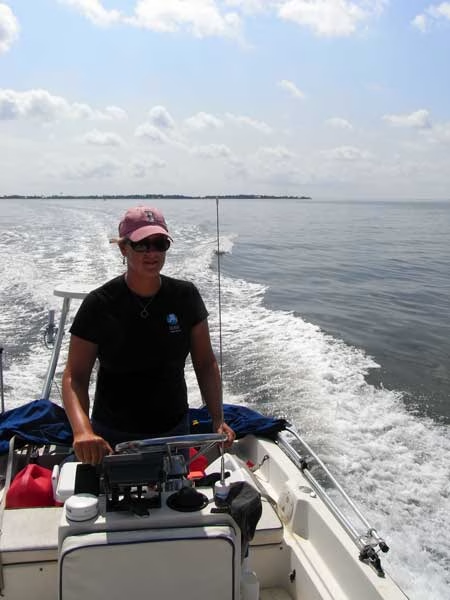
Originally from New Hampshire, Gazda earned her bachelor’s degree in marine and freshwater biology from the University of New Hampshire before pursuing a master’s in marine biology at the University of Massachusetts Dartmouth. Her master’s research on bottlenose dolphins in Cedar Key, Fla., introduced her to the Sunshine State, which would later become her home. After working at the New England Aquarium in Boston, she decided to continue her academic career and earned a Ph.D. from the University of Massachusetts Boston, all while conducting research in Cedar Key and frequently commuting between Florida and Massachusetts.
Gazda’s research on bottlenose dolphins has been a defining part of her career, beginning with her master’s thesis in Cedar Key. Over the years, her work has expanded to focus on understanding how dolphins use different habitats and how human activity affects their populations. “Dolphins are very social animals, and understanding how they interact with their environment is key to protecting them,” she said. “We need years of data to really understand the patterns and behaviors that are important to the survival of these dolphins.”
Her research, combining both fieldwork and data analysis, has contributed valuable insights to aid the conservation of this protected species, highlighting the delicate balance between human development and marine life.
Gazda’s dedication to marine biology and desire to further her research in Cedar Key motivated her to pursue a teaching career in Florida. “An opportunity opened up at UF that was primarily teaching and it also made me within driving distance of Cedar Key,” she said. After joining the university, teaching became her primary role as she remained committed to her research on bottlenose dolphins. This balance between instruction and research allows Gazda to continue her fieldwork while fostering the next generation of biologists.
Pairing Online Learning with Real-World Science
Since 2018, Gazda has been developing and teaching online biology courses at UF Online, covering topics like Introductory Biology I and II, General Ecology, and Animal Behavior. She has seen attitudes toward online education change over the years, particularly after the COVID-19 pandemic. “When I started, people didn’t really love the idea of online courses,” she said. “As students’ lives became busier, having asynchronous courses became crucial. It allowed them to access the material at their own pace, without being tied to a specific schedule, which made it easier for people to juggle other responsibilities.”
However, teaching biology online presents unique challenges. “Students in an online course need more than just passive lectures,” she said. Gazda has embraced innovative solutions and engaging activities, like creating lab kits and encouraging outdoor data collection. “We’ve designed demonstration videos for my intro bio labs that were filmed in my own kitchen. It shows students that you can do real science anywhere—you don’t have to be in a traditional lab.” For her General Ecology and Intro Biology II labs, she asks students to conduct fieldwork in their own backyards. “I’ve had students collect data in their apartment parking lot.”
Gazda’s peers have applauded her innovative approach. Her Animal Behavior course earned an Exemplary Course distinction, and her General Ecology course was recognized as an Exemplary Course for overall excellence and quality course materials by UF’s Center for Teaching Excellence.
Empowering UF Online Students from Afar
Gazda sees online learning as a powerful tool that expands access to education for both students and instructors. “I’ve had students logging in from all over the world, some in the military, others traveling for work, and many with full-time jobs,” she said. The flexibility of online courses not only makes education accessible to more students but also enables Gazda to balance her own professional and personal goals while staying fully available to her students. “The first time I taught Animal Behavior online, I was in Japan and did impromptu lectures when we saw snow monkeys. I was completely available to my students despite being across the world.”
Teaching biology at UF Online brings Gazda great joy and professional fulfillment, in part thanks to her department’s supportive environment and UF’s exceptional online teaching resources. “I have some really fantastic colleagues,” she said. “The support from the professional development teams at the university has been really great, like UF’s Center for Teaching Excellence and Center of Online Innovation and Production (COIP).”
She urges her colleagues to explore online teaching, emphasizing its rewarding and valuable experience. “I encourage the biology faculty to put a course online. I’ve never heard anyone have a bad outcome from doing it,” she said. She also helps improve online course quality across the university by serving on the UF Quality Advisory Board for online courses.
Gazda’s passion for biology and dedication to student engagement shines through in her teaching philosophy. “I tell my undergrads—I’m a fan of biology. There’s so much we don’t know, especially about the oceans, and that’s what makes it so fascinating.” Through her work with UF Online, Gazda continues to inspire students while ensuring that online learning remains interactive, innovative, and accessible. Her story is a testament to the transformative potential of digital education, proving that science knows no boundaries—whether in a lab, a kitchen, or halfway across the world.
Explore a Microbiology & Cell Science Online Degree
Get started on your own path to an exciting career in the sciences with a degree in Microbiology and Cell Science. Offered by the College of Agricultural and Life Sciences, the Microbiology and Cell Science major allows students to experience first-hand research and participate in engaging labs, all while being taught by UF’s renowned faculty. Ready to take the next step? Learn more about UF Online’s Microbiology degree program below.